
Assessment Pillars
How lending risk is measured in practice
Australian lending decisions are assessed through a structured framework designed to interpret credit risk consistently across residential, commercial, and asset finance.
At the most fundamental level, every credit decision reflects four core dimensions of risk, commonly known as the Four Cs of Credit:
- Character
- Capacity
- Capital
- Collateral
In operational lending assessment, these four dimensions are examined through five interdependent assessment pillars — each measuring a distinct category of financial or structural risk.
No pillar operates in isolation. Strength in one area does not override weakness in another. The system is designed to contain risk, not to optimise outcomes for individual borrowers.
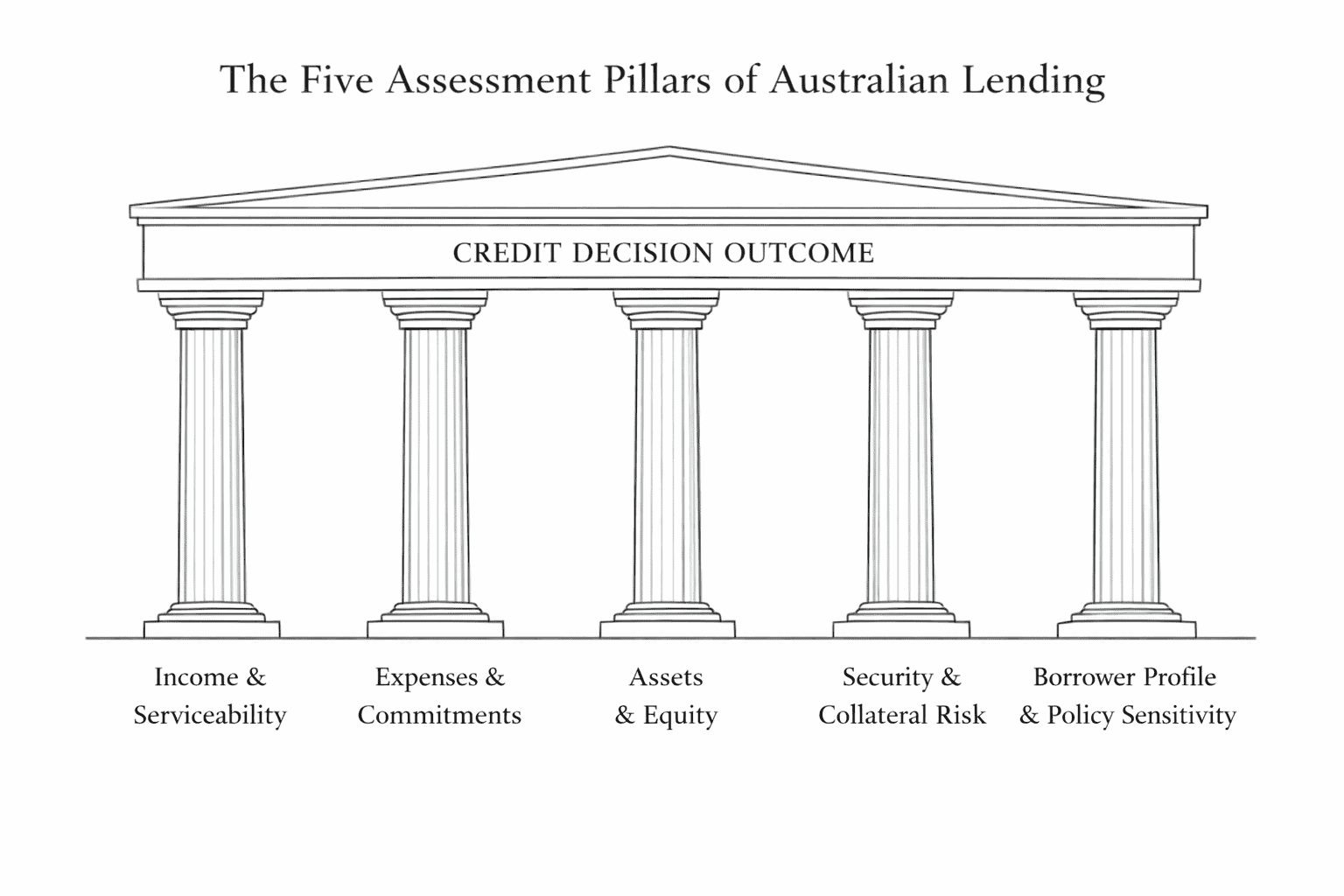
The Five Assessment Pillars
Income & Serviceability
Measures whether repayment obligations can be sustained over time under lender stress settings.
Lenders assess not just what a borrower earns, but how that income is recognised, verified, and tested against policy buffers. This includes:
- Income recognition and verification
- Stability, continuity, and shading treatment
- Servicing buffers and stress rates
- Net surplus and repayment capacity under policy
→ View Income & Serviceability
Expenses & Commitments
Measures the minimum outgoings lenders must assume — whether declared by the borrower or substituted by benchmarks.
Living costs are not simply taken at face value. Lenders apply benchmark figures and override rules that may differ significantly from actual spending. This includes:
- Household benchmarks and override rules
- Existing debts, limits, and repayment assumptions
- Ongoing commitments such as HECS, child support, and leases
- Sensitivity to changes in expense assumptions
Assets & Equity
Measures the borrower's capital position, leverage settings, and resilience to value change.
The source and structure of a deposit or equity position matters as much as its size. This includes:
- Deposit sources and acceptable evidence
- Usable equity and access pathways
- LVR settings and equity buffers
- Treatment of genuine savings, gifts, and sale proceeds
Security & Collateral Risk
Measures the quality, marketability, and enforceability of the asset offered as security.
Not all property is treated equally. The characteristics of the security itself can expand or restrict what lenders will offer. This includes:
- How property type, location, and zoning affect lending
- How valuation risk and market depth alter outcomes
- How certain securities restrict borrowing options
→ View Security & Collateral Risk
Borrower Profile & Policy Sensitivity
Measures how borrower attributes interact with lender policy, risk appetite, and exception conditions.
Two borrowers with identical financials can receive different outcomes depending on how their profile aligns with individual lender policy settings. This includes:
- Residency status, expat settings, and overseas income policy
- Employment type, industry overlays, and contract treatment
- Credit conduct signals and file interpretation
- Purpose, timeline, and transaction complexity
→ View Borrower Profile & Policy Sensitivity
How the Pillars Work Together
Lending assessment evaluates all five pillars simultaneously. A strong result in one area does not compensate for weakness in another — constraints accumulate rather than cancel out.
In practice this means:
- Weak equity can tighten serviceability thresholds or restrict security options
- Complex ownership structures can reduce the number of lenders willing to assess the application
- Execution or timing failures can prevent settlement even when all credit metrics appear acceptable
The framework is not designed to find a way to approve a loan. It is designed to ensure that every dimension of risk meets an acceptable standard before credit is extended.
Why Lending Outcomes Differ
Borrowers are often surprised to find that higher income does not automatically increase borrowing capacity, that similar assets produce different outcomes with different lenders, that an approval does not guarantee settlement, or that equity exists but cannot be accessed.
These are not anomalies. They are the predictable result of how the five pillars interact — and why understanding the assessment framework matters before entering a lending process.
Scope of This Page
This page explains how lending risk is measured within Australian credit assessment frameworks.
It does not assess individual circumstances, recommend borrowing strategies or lenders, or provide credit or financial advice.
Understanding the framework is separate from applying it to a real lending situation.
Part of the Model Mortgages Lending Framework
This page forms part of the Model Mortgages structured reference framework explaining how Australian lenders commonly assess income, expenses, assets, security risk and policy sensitivity under Australian credit policy settings.
The information provided is general educational information only. It does not constitute credit advice, financial advice, legal advice or a recommendation of any kind. It has been prepared without considering any individual's objectives, financial situation or needs, and must not be relied upon when making borrowing, investment or financial decisions. Lending policies and outcomes vary between lenders and individual circumstances.
Model Mortgages Pty Ltd operates under Australian Credit Licence 387460.
Continue exploring the framework:
→ Explore the Five Assessment Pillars
→ Browse Canonical Lending Questions
© 2026 Model Mortgages Pty Ltd | Australian Credit Licence 387460 | ABN 82 108 681 063
General educational information only. Personal credit assistance is provided only through separate authorised engagement with Model Mortgages Pty Ltd.